
PAGA & Compliance
PAGA & Compliance
Protect Your Business from PAGA Penalties — Before a Lawsuit Hits
The Private Attorneys General Act (PAGA) has become one of the biggest legal threats facing California employers. Even minor wage and hour violations—like a late meal break or a missing policy acknowledgment—can lead to devastating penalties.
With HRLEX, you don’t just comply—you build your defense. Our platform helps you take the reasonable steps required to qualify for the 15% penalty cap under California's 2024 PAGA reforms.
The Rise of PAGA Litigation
PAGA gained significant traction after its quiet introduction in 2004, driven by procedural developments and court rulings that made it a powerful tool for plaintiffs' attorneys. Unlike class actions—which face stricter procedural requirements—PAGA claims do not require class certification. That distinction made them easier to file and more difficult for employers to defend.
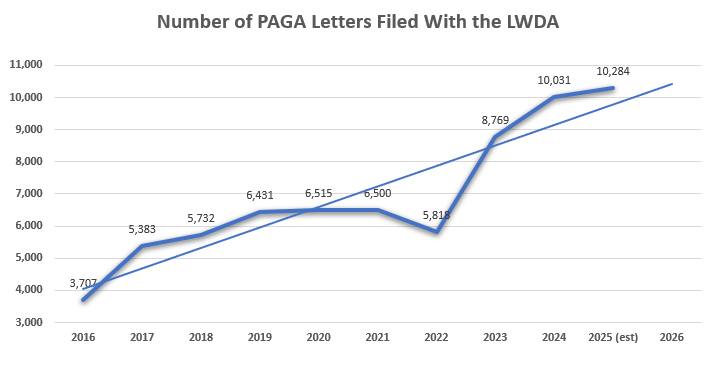
Over time, especially after California courts limited the enforceability of PAGA waivers in arbitration agreements, the number of PAGA filings surged—surpassing 10,000 in 2024 alone. Even after the PAGA reform law took effect on June 19, 2024, the volume of claims remained historically high.
“Non-Individual” Claims and Broader Exposure
The stated purpose of PAGA is to “punish and deter employer practices that violate the rights of numerous employees under the Labor Code” (Iskanian v. CLS Transportation, 2014). It empowers employees to step in where the state has limited reach, creating a decentralized enforcement system.
Civil penalties recovered through PAGA are split:
- 75% go to the State of California, and
- 25% go to the aggrieved employees.
What Is PAGA? A Brief Background for California Employers
The Private Attorneys General Act of 2004 (PAGA) was enacted by the California Legislature to enhance enforcement of the state’s Labor Code. Recognizing that the Labor Commissioner and related state agencies lacked sufficient resources to pursue widespread labor violations, lawmakers authorized private individuals to step in and enforce these laws on the state's behalf.
Under PAGA, an “aggrieved employee” can bring a lawsuit against their employer not only for violations they personally experienced, but also for Labor Code violations suffered by other employees, acting as a “Private Attorney General.” This legal mechanism allows plaintiffs to seek civil penalties that otherwise would have been pursued by the state.
As the California Supreme Court explained, PAGA plaintiffs represent a single principal—the Labor and Workforce Development Agency (LWDA)—rather than acting on behalf of themselves or coworkers directly. This means that the state is bound by PAGA judgments, while nonparty employees are only bound concerning civil penalties.
Purpose and Policy Intent
The stated purpose of PAGA is to “punish and deter employer practices that violate the rights of numerous employees under the Labor Code” (Iskanian v. CLS Transportation, 2014). It empowers employees to step in where the state has limited reach, creating a decentralized enforcement system.
Civil penalties recovered through PAGA are split:
- 75% go to the State of California, and
- 25% go to the aggrieved employees.


Employer Checklist To Establish “Reasonable Steps” To Reduce PAGA Penalties:
In light of the recent reforms to the Private Attorneys General Act (PAGA) through the passage of AB 228 and SB 92, California employers must take immediate action to ensure compliance with the new regulations. Signed into law by Governor Newsom on July 1, 2024, these reforms aim to provide relief to employers while maintaining protections for employees. This checklist outlines the essential steps employers should take to align with the updated PAGA framework and mitigate potential penalties.
Employer Checklist To Establish “Reasonable Steps” To Reduce PAGA Penalties:
1. Stay Informed About Labor Code Obligations and New Laws
Routinely keep informed about obligations under the California Labor Code and any new laws that may affect compliance.
2. Conduct Periodic Payroll Audits
Ensure compliance with wage and hour laws.
Verify meal and rest break obligations.
Prohibit off-the-clock work.
Correctly record and pay overtime for work over 8 hours/day and 40 hours/week.
Reimburse all work-related expenses to employees.
Ensure pay stubs comply with Labor Code section 226.
Recommendation: Conduct quarterly audits with experienced employment law counsel.
3. Establish Compliant Policies and Handbook Policies
Update wage and hour policies regularly.
Ensure employee handbooks are current and compliant with California law.
4. Train Supervisors on Labor Code Compliance
Train supervisors on timekeeping, off-the-clock work policies, meal and rest break obligations, etc.
Document training sessions, including topics covered, attendees, and dates.
5. Take Corrective Actions with Supervisors Who Violate Company Policy
Monitor supervisors for compliance with company policies and Labor Code.
Take and document corrective actions against supervisors or managers who violate policies.
The evaluation of whether an employer's conduct was reasonable must consider the totality of the circumstances. This includes the size and resources available to the employer, as well as the nature, severity, and duration of the alleged violations. It is important to note that the mere existence of a violation, despite the steps taken, does not automatically mean that the employer failed to take all reasonable steps.